
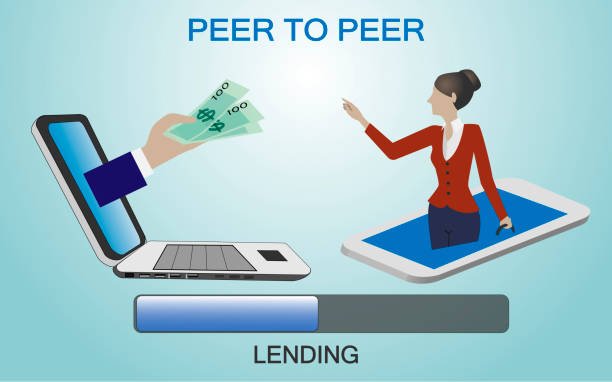
In today’s financial world, a new form of borrowing and lending has emerged on the scene. It is a fresh approach towards lending known as Peer to Peer(P2P) lending. This innovative method connects individuals looking for loans with those who are willing to lend their money as loan or finance to an individual. In this blog, let’s explore what P2P lending is, how it works, its advantages and risks, and its rising popularity.
What is Peer-to-Peer Lending?
Peer-to-Peer lending or P2P lending in short, is a concept that brings borrowers and lenders on a same platform, instead of relying on traditional financial institutions, Banks and NBFC’s. These platforms operate online, making the lending process available to a larger audience.
P2P Lending Process
Signing Up: Firstly, to avail P2P lending, individuals will have to sign up on a P2P lending platform. These platforms act as intermediaries, facilitating the connection between a number of borrowers and lenders.
Submission of Application: The borrowers will have to submit their loan applications on the platform, mentioning the purpose of the loan, the amount needed, and their credit standing. The P2P platform will then assess the borrower’s credit risk using various criteria like CIBIL credit score for individuals and credit rating for business houses.
Listing on the platform: Once the application gets approved, it is listed on the platform making it visible to all potential lenders. The lenders visiting the platform goes through the different loan listings after considering factors like interest rates, purpose of the loan, and the borrower’s credit profile.
Funding by lenders: Then, the lenders who are interested can opt to fund a part or the entire loan amount. This creates a different pool of lenders lending to a single borrower’s loan application.
Repayment: The borrowers can repay the loan in instalments, and the P2P platform distributes these payments among the different lenders according to their share of lending. The lenders earn the respective interest amounts as per rates agreed with the borrower at specified intervals.
Advantages of P2P Lending
Wide customer base: Since P2P lending provides borrowing and lending opportunities to a larger audience, those individuals or businesses who find it challenging to avail traditional loans from banks can easily secure alternative financing solutions through P2P lending.
Competitive Interest Rates: As there is an absence of any overhead costs incurred by the lenders here, borrowers may get competitive interest rates than traditional banks. This can be quite attractive for individuals or businesses seeking loans at affordable rates.
Diversification for lenders: Through P2P lending, the lenders can diversify their lending or investment into different portfolios. Instead of putting all their money in one place, they can spread it across multiple loan borrowers, mitigating the risk involved.
Online Process: Since the process is online and streamlined in P2P lending platforms, the borrowers and lenders can apply for loans or invest/lend from the comfort of their homes through internet, reducing paperwork and time consuming procedures.
Type of Risks involved
Default Risk: The primary risk for lenders in P2P lending is the risk of default by the borrowers on their loans. Although the platforms use various risk-assessment tools to mitigate risks, there is always a level of uncertainty and risk involved.
Regulatory Risks: Since the P2P lending sector is relatively young and is subject to changing regulations, any change in the legal and financial frameworks could impact the operations and returns for both the borrowers and the lenders.
Lack of Insurance: Unlike traditional bank deposits/advances, P2P lending are not fully insured by any government authorities. If a borrower defaults in repaying the loan, risk of losing the funds lent is very high.
Marketplace Risks: The success of any P2P lending platform is largely dependable on its ability to attract both borrowers and lenders. Failure of the same may affect the overall health and the returns of the parties involved.
P2P lending in India
Over the past decade, P2P lending has gained notable importance in India. For e.g.; Lendbox, Faircent and i2i Funding etc. are some of the RBI certified P2P platforms operating in India. Other platforms like Receivables Exchange of India Ltd (RXIL),M1 Exchange and Trade Receivables Discounting System(TReDS) are also popular in the Fintech sectors in India. This sector has seen a substantial growth as more individuals recognize the benefits of this alternative lending model. As technology continues to advance, P2P lending platforms are likely to become even more user-friendly, secure, and efficient.
Peer-to-Peer lending represents a paradigm shift in the world of finance, which offers a decentralized and inclusive approach to borrowing and lending. Although it comes with its set of risks, the benefits, including accessibility, competitive interest rates, and diversification opportunities, make it an attractive option for many people. As the P2P lending sector continues to evolve, it’s essential for both borrowers and lenders to stay informed and adapt to the changing dynamics of this innovative financial ecosystem.